Licensing as Organizational Infrastructure
Can Veiled Dominion build a people-over-profit creative economy


PIXIE · PUBLIC RESEARCH NOTE
Doctoral pitch context · University of East London
Filed · September 2026
Research status: This is public development writing connected to a proposed doctoral research direction. It presents questions and provisional design propositions—not completed research, institutional approval, legal advice, or predetermined findings. The University of East London has not reviewed or endorsed this article.
ABSTRACT
What happens when licensing is treated not as paperwork added after creation, but as part of the creative system itself?
This public research note positions Veiled Dominion—an open game prototype concerned with restraint, regulation, asymmetric systems, and inclusive architecture—as a practice-based case through which to examine that question.
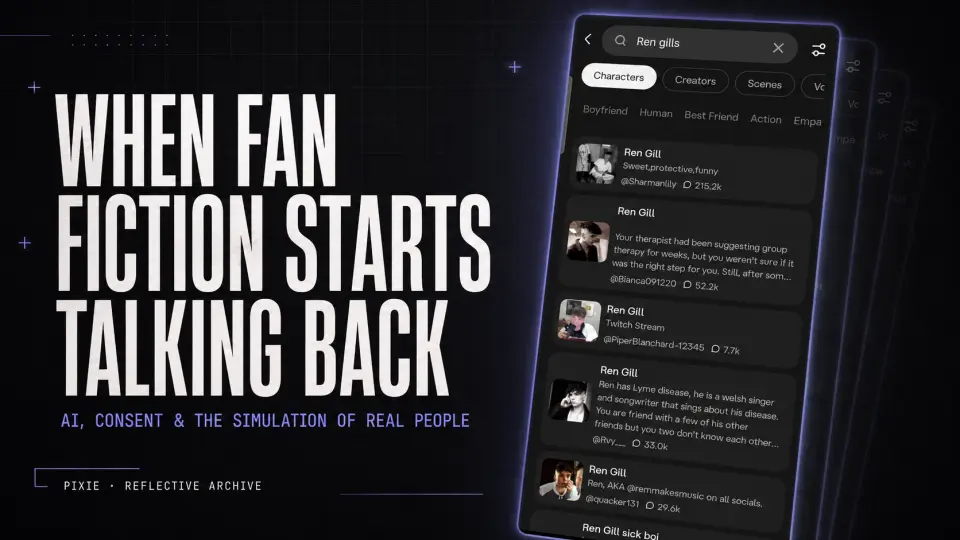
The immediate inquiry began with unauthorized-looking AI chatbots modeled on a living musician. That example exposed a broader structural problem: platforms can convert identity, creative labour, and audience attachment into value before consent, attribution, compensation, and remedy have been adequately designed.
Veiled Dominion does not presently reproduce that situation. Its characters and worldview are original, and its documented use of AI is directed toward organization, debugging, restructuring, exploration, and technical iteration. Yet the project does not currently possess a complete public framework for fan participation, contributor compensation, AI-training permissions, digital replicas, commercial licensing, or revocation.
It therefore passes a values test more convincingly than it passes a licensing-readiness test.
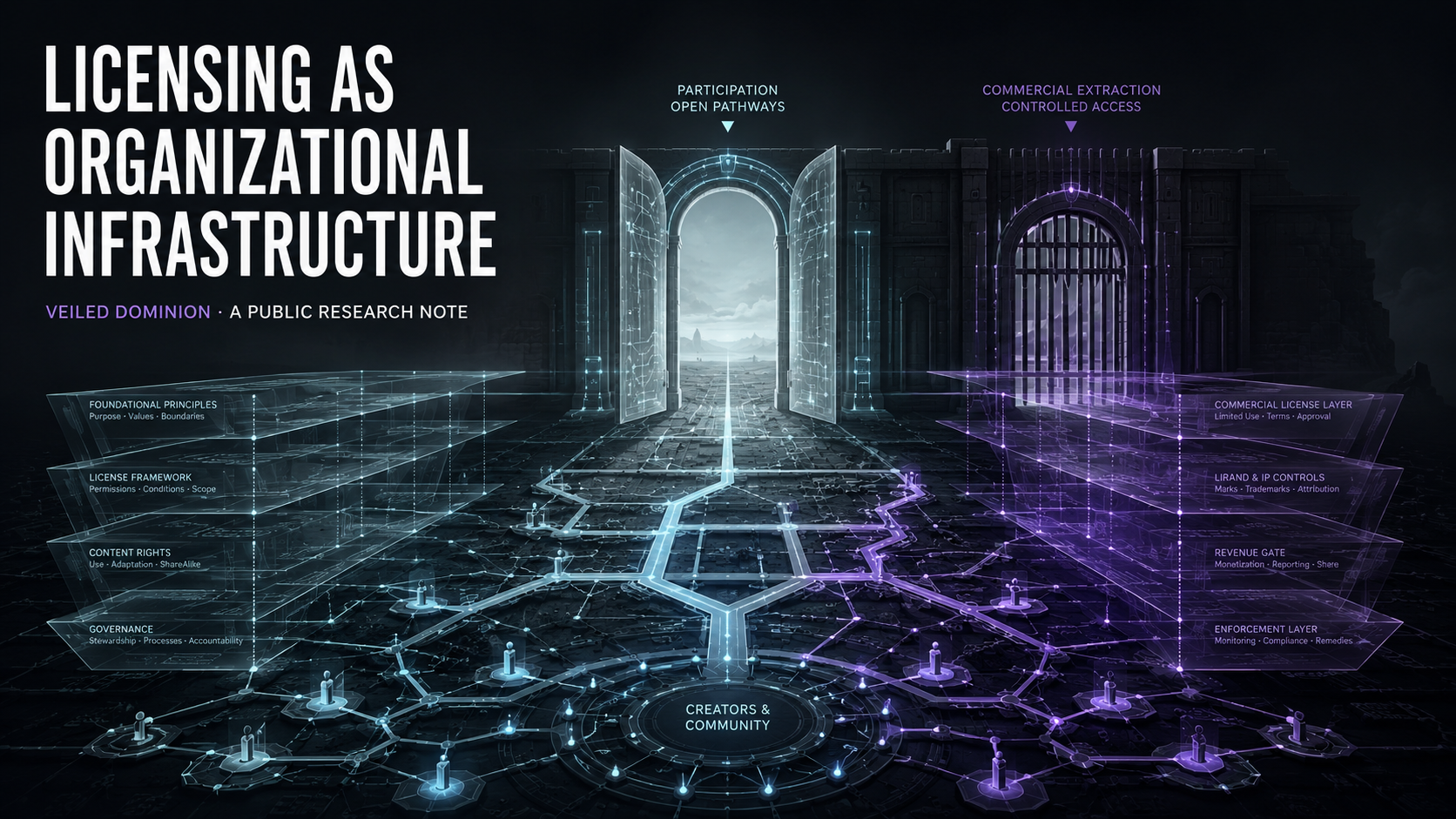
The doctoral proposition is that a creative world may also function as organizational infrastructure: a site where rules governing play, authorship, labour, consent, access, and value can be designed, observed, documented, and critically evaluated together.
THE RESEARCH PROBLEM
Independent creative projects routinely describe themselves as open, collaborative, community-led, or creator-first. Those terms express intentions. They do not automatically create permissions, protections, or economic rights.
“Open” may mean that development is visible. It may mean that a prototype is free to play. It may imply that community creativity is welcome. Without a license, however, the participant cannot reliably know which meaning governs.
The same ambiguity appears in AI-mediated culture. A platform may permit users to create a character under a real person’s name, upload a recognizable photograph, and generate first-person dialogue. The technical availability of those features says nothing conclusive about authorization.
This distinction produces the central research problem:
How might an independent creative organization translate people-over-profit values into enforceable rules for participation, attribution, consent, compensation, and technological reuse?
The organizational question is not whether revenue should exist. Sustainable creative practice requires resources. The question is how value is allocated, who carries risk, whose permission matters, and whether the infrastructure remains accountable when a project grows.

WHY VEILED DOMINION?
Veiled Dominion is the primary creative case within a proposed longitudinal practice-research design. It explores strategic mechanics through restraint, regulation, asymmetric systems, and inclusive architecture. Its four-player rules repository serves as the present rules authority, while Duet remains experimental. Project materials are intended to distinguish canonical, experimental, historical, and unresolved decisions.
That existing structure matters. The project already recognizes that an unlabeled status creates confusion. A mechanic must be identified as authoritative or provisional. A design decision must be traceable through its development history.
Licensing can be approached with the same discipline.
A contribution can be identified as owned, licensed, experimental, withdrawn, community-created, or rights-unresolved. AI involvement can be documented. A voice performance can carry permissions different from a written contribution. A fan work can remain culturally welcome without being mistaken for canonical or commercially authorized material.
Veiled Dominion therefore offers more than content to study. It offers a living organizational environment in which governance propositions can be prototyped alongside game systems.
CURRENT POSITION: WHAT WORKS
Original creative authority
The fiction, characters, and worldview are documented as the creator’s original work. This reduces—but does not eliminate—chain-of-title risk. External music, photographs, performances, typefaces, commissioned artwork, and community submissions would still require their own records.
Bounded use of AI
AI is documented as supporting the process rather than replacing the claim of human authorship. Current uses include documentation, debugging, organization, restructuring, exploration, and technical iteration.
This is compatible with a people-over-profit framework, provided the project develops a consistent record of which tools affected which assets and what permissions governed their inputs.
Explicit canonical status
The separation of canonical, experimental, historical, and unresolved material is already a governance mechanism. It provides a foundation for equivalent rights labels:
- canonical and internally owned;
- licensed contribution;
- community-created and unofficial;
- experimental and not authorized for commercial use;
- rights unresolved; and
- withdrawn or superseded.
Alignment between theme and governance
Veiled Dominion examines regulation, restraint, and unequal power through play. A licensing system that limits infrastructural power would extend those ideas into production practice. The method of making the work would become part of what the work investigates.

CURRENT POSITION: WHAT REMAINS UNBUILT
Veiled Dominion currently has no documented public terms specifying:
- what “open prototype” permits;
- whether fan fiction, streaming, modification, or commercial accessories are allowed;
- how contributors are credited and compensated;
- whether project material may be used for AI training or fine-tuning;
- how voice, likeness, and digital-replica consent would operate;
- what fees an operating platform could deduct;
- whether commercial licenses may be exclusive or sublicensed;
- how consent expires or is revoked; or
- how corrections, disputes, takedowns, and appeals are handled.
These omissions do not establish exploitation. They establish institutional incompleteness.
The distinction is important for practice research. The purpose is not to present Veiled Dominion as an already perfected ethical model. It is to document how a founder-practitioner recognizes, negotiates, and attempts to repair governance gaps before scale turns them into harm.
A PROPOSED THREE-TIER LICENSE
1. Community license
A free, plain-language license could permit play, discussion, reviews, educational use, noncommercial fan fiction, and clearly unofficial fan art.
Conditions could include attribution, non-deception, respect for contributor credits, and restrictions on synthetic voices, identity simulation, and unapproved commercial use.
2. Independent creator license
Small creators could receive broad permission with no upfront payment. A graduated contribution would begin only after the derivative project crosses a stated revenue threshold.
This separates experimentation from extraction: participation remains accessible, while successful commercial use contributes back to the creative ecosystem.
3. Commercial identity and intellectual-property license
Affirmative, specific permission would be required for official adaptations, commercial games, advertising, merchandise, character chatbots, synthetic performances, voice cloning, or model training.
Consent to one use would not imply consent to another. Permission to reproduce an illustration, for example, would not include permission to train a model on it or animate the artist’s identity.
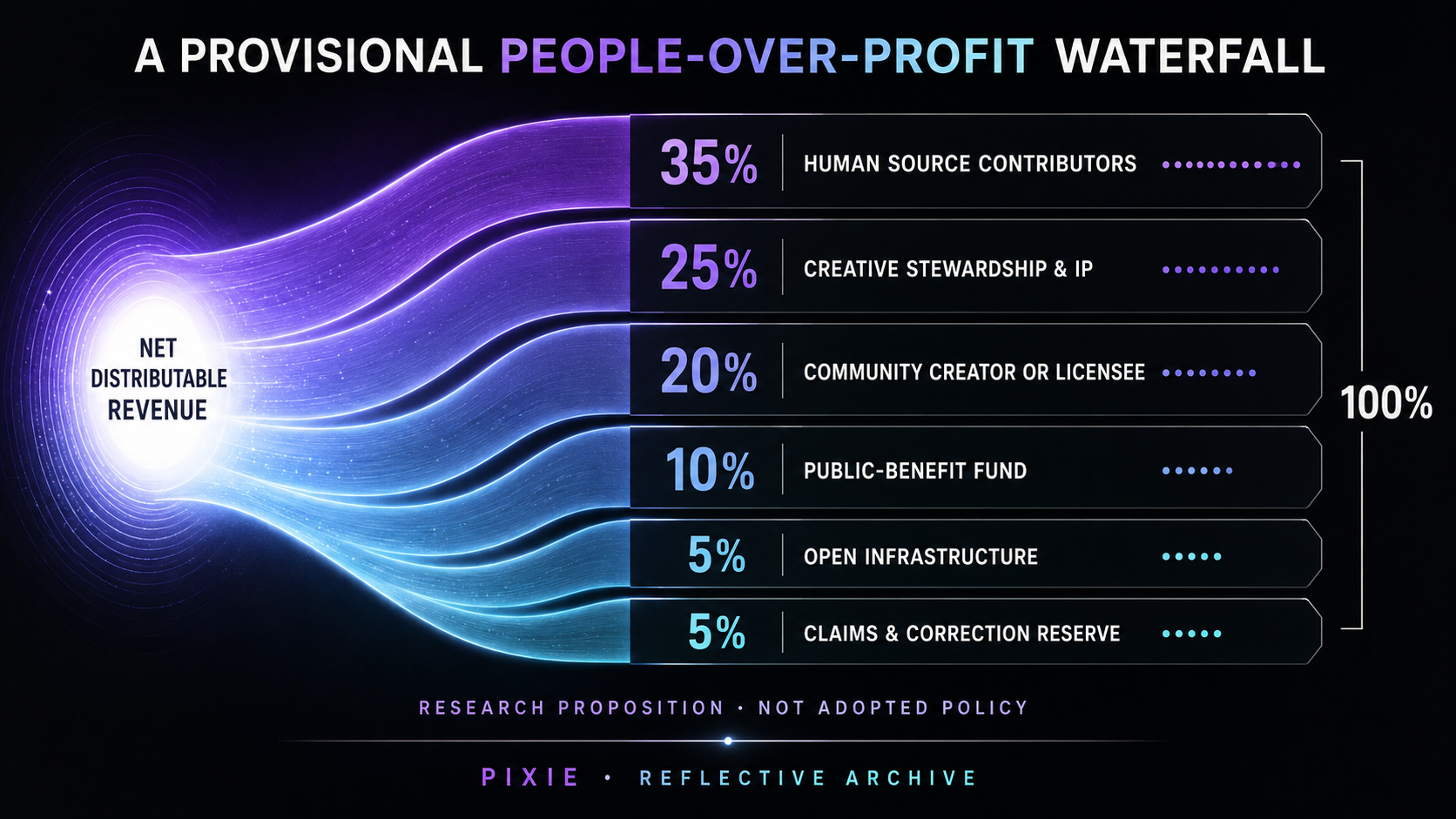
A PROVISIONAL PEOPLE-OVER-PROFIT WATERFALL
The following is a research proposition for evaluation, not an adopted Veiled Dominion policy:
Allocation | Provisional share | Function |
|---|---|---|
Human source contributors | 35% | Compensates artists, writers, musicians, performers, designers, and other contributors |
Creative stewardship and IP | 25% | Sustains the originating creative practice, archive, and continued development |
Community creator or licensee | 20% | Rewards transformative labour and distributed participation |
Public-benefit fund | 10% | Supports aligned community or access initiatives |
Open infrastructure | 5% | Maintains licensing, provenance, and governance systems |
Claims and correction reserve | 5% | Funds attribution repairs, disputes, takedowns, and remediation |
Total | 100% |
Taxes, refunds, and unavoidable payment charges would be accounted for before distribution. Any administrative or platform fee would be separately disclosed and capped.
This model must be tested rather than celebrated in advance. Questions include whether the categories are sufficiently distinct, whether percentages remain viable at different revenue levels, whether contributors prefer upfront payment or participation, and whether a public-benefit allocation can be governed without becoming symbolic.
THE CONTRIBUTOR BILL OF RIGHTS
A people-over-profit claim should become auditable through contributor experience. A proposed Contributor Bill of Rights would therefore include:
- Written and persistent credit.
- Ownership and licensing terms established before publication.
- Compensation terms agreed before commercial exploitation.
- No undisclosed conversion into work made for hire.
- No AI training without separate, affirmative permission.
- No synthetic voice, face, or digital replica without specific consent.
- Access to relevant revenue and usage statements.
- A defined correction and attribution process.
- A defined exit, expiration, and revocation process.
- No sublicensing beyond the expressly agreed scope.
These provisions would require jurisdiction-specific legal review before contractual adoption. Their research value lies in examining how abstract commitments become operational responsibilities—and where those responsibilities encounter economic or organizational resistance.
THE RIGHTS ENVELOPE
Every official asset could carry a structured rights record containing:
Field | Question answered |
|---|---|
Creator | Who made this? |
Rights holder | Who may authorize its use? |
Contribution date | When did it enter the project? |
Canonical status | What role does it hold in the creative world? |
Permitted uses | What may others do with it? |
AI involvement | How did computational systems affect it? |
Training permission | May it enter a training or fine-tuning dataset? |
Voice/likeness permission | Does it represent or reproduce a person? |
Revenue participation | Who shares in monetization? |
Expiration | When does permission end? |
Revocation status | Has authorization changed? |
Provenance | Which sources and transformations produced it? |
This could begin as a repository record. It does not require a blockchain. A later phase could investigate whether signed records and portable labels—potentially using systems such as AT Protocol—allow permissions and revocations to travel across services.
The protocol would carry evidence. It would not decide legality. Platforms would still determine distribution and enforcement; affected people would still require accessible remedies.
PROPOSED RESEARCH QUESTIONS
The practice case suggests the following doctoral questions for refinement:
- How can the design of a fictional world function as organizational infrastructure for an independent creative practice?
- How are values such as restraint, inclusion, consent, and people-over-profit translated into technical, contractual, and economic rules?
- What tensions emerge when an open creative prototype moves toward collaboration, commercialization, or platform distribution?
- How can provenance and licensing records support accountability without imposing prohibitive administrative burdens on small creative organizations?
- What can the evolution of Veiled Dominion reveal about founder-practitioner leadership, positionality, and power?
These are research directions, not predetermined findings.
PROPOSED METHODOLOGY
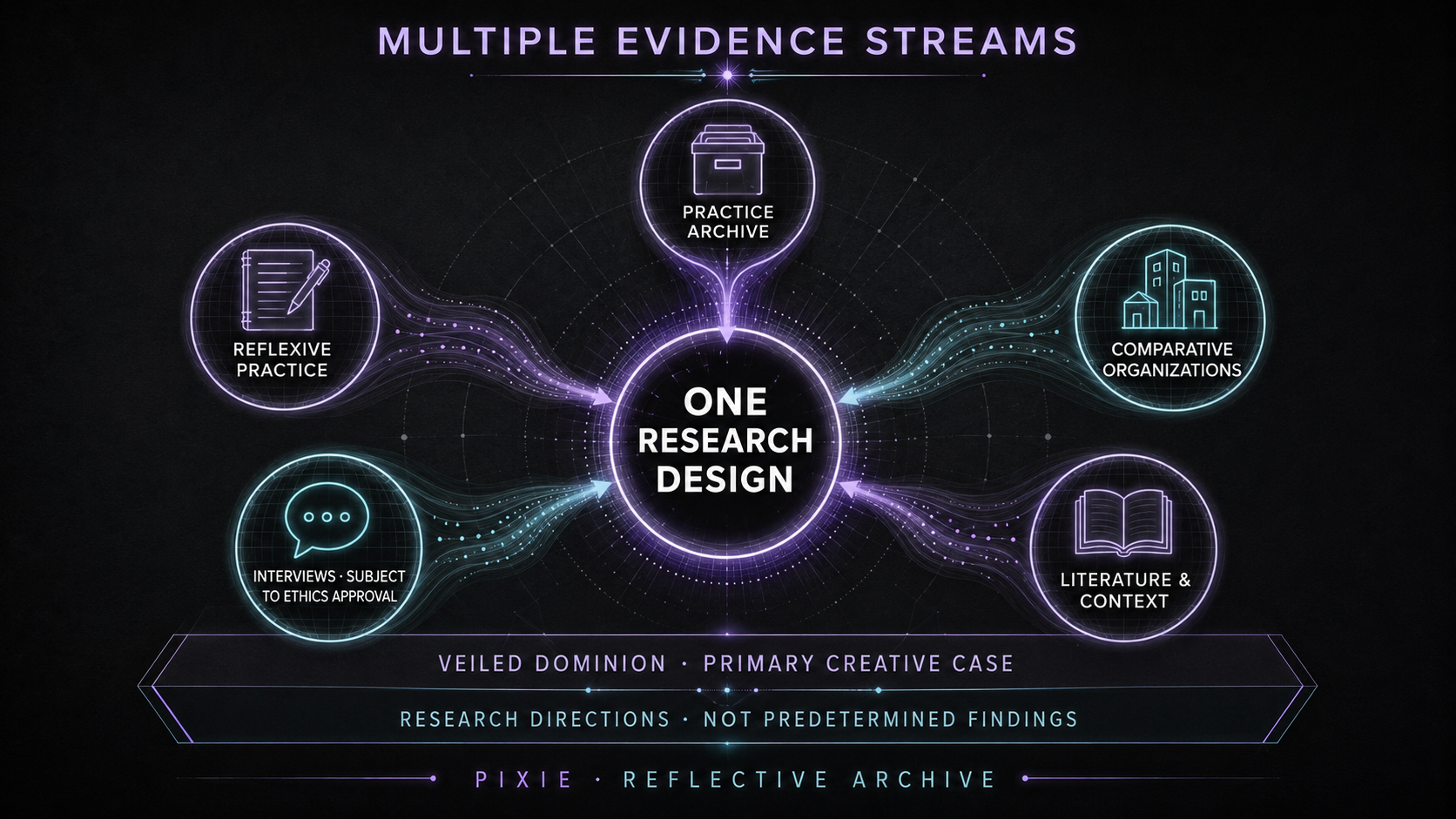
The wider doctoral design is summarized as one research design, multiple evidence streams.
Longitudinal practice archive
Evidence may include repositories, design documents, production records, version histories, prototypes, pitch materials, licensing drafts, governance changes, and public development writing published through PIXIE.
Reflexive practice
The researcher is also the founder-practitioner. That position provides access to decisions as they occur, but creates risks of self-justification and selective interpretation. The research would therefore require explicit reflexivity concerning positionality, potential bias, and the distinction between professional decision-making and research interpretation.
Comparative organizational cases
Approximately two to three independent or founder-led creative organizations may provide comparative evidence concerning governance, licensing, collaboration, and commercialization.
Semi-structured interviews
Any interviews would be subject to ethics approval and appropriate consent, confidentiality, data-management, and anonymization procedures. This public note does not recruit participants or treat public audiences as research subjects.
Literature and contextual analysis
Practice evidence would be analyzed alongside literature concerning organizational leadership, creative industries, independent game production, narrative and world-building, accessibility, intellectual property, platform governance, and practice research.
ETHICS AND PUBLIC WRITING
PIXIE functions as a reflective archive and public writing space. That role must remain distinct from formal research participation.
Public documentation can expose the researcher’s reasoning, design decisions, uncertainties, and revisions. It cannot substitute for ethics approval where people are recruited, interviewed, observed, or analyzed as research participants.
Any doctoral study developed from this proposition would need to follow the University of East London’s applicable research regulations and ethics processes. UEL states that research proposals should identify the topic, research questions, methodology, and importance of the research. Its research framework also requires appropriate ethical, legal, and professional standards.
The public archive should therefore make visible:
- which material documents professional practice;
- which material constitutes reflective research data;
- which claims remain provisional;
- what AI systems contributed;
- how third-party rights were handled; and
- when formal ethics approval applies.
PROPOSED CONTRIBUTION
The study may contribute across four connected areas:
Organizational leadership
It may show how founder values become—or fail to become—governance, contracts, technical constraints, and distributions of power.
Creative practice
It may demonstrate how world-building and game-system design can inform the organization producing the work.
Practice research
It may provide a transparent model for combining repositories, prototypes, decision records, public reflection, and reflexive analysis without presenting practice documentation as self-validating evidence.
Industry practice
It may produce reusable tools: a community license, contributor rights framework, AI rider, revenue-waterfall model, provenance schema, and correction process designed for independent creative organizations.
The intended contribution is not a claim that one economic formula solves creative exploitation. It is a method for making values testable through infrastructure.
PROVISIONAL FINDING
Veiled Dominion currently meets the values proposition, partially meets the provenance proposition, and does not yet meet the licensing-readiness proposition.
That is not the end of the inquiry. It is the point at which the inquiry becomes researchable.
The project’s most consequential prototype may not be a game mechanic. It may be the organizational system surrounding the game: who may participate, who must consent, who is paid, who can refuse, what remains open, and what happens when creative attention becomes commercial value.
Let people participate freely. Make extraction expensive. Pay every human before rewarding the platform.
The challenge is to determine whether that principle can survive contact with contracts, collaborators, platform dependencies, unequal bargaining power, and the practical economics of independent production.
That is the work Veiled Dominion is now positioned to undertake.
SOURCES AND CONTEXT
- University of East London, Applying for postgraduate research.
- University of East London, Postgraduate research and PhDs.
- University of East London, Research and Research Ethics Handbook.
- University of East London, Research Degrees regulations.
- University of East London, School of Arts and Creative Industries research.
- AT Protocol, Identity, Moderation, and Labels.
- W3C, ActivityPub Recommendation.
- Character.AI, Impersonation Policy.
- U.S. Copyright Office, Fair Use Index.
- UK Intellectual Property Office, Exceptions to copyright.
PUBLICATION NOTE
This article is published for educational and research-development purposes through PIXIE, a reflective archive documenting systems, incentives, architecture, and creative practice. It does not provide legal advice, announce an adopted commercial policy, recruit research participants, or represent the views of the University of East London.
title: "Licensing as Organizational Infrastructure"
subtitle: "Can Veiled Dominion build a people-over-profit creative economy?"
slug: "veiled-dominion-people-over-profit-licensing"
author: "PIXIE"
date: "2026-09-04"
description: "A public research note examining Veiled Dominion as a practice-based case for consent, contributor rights, AI governance, and people-over-profit licensing."
tags:
- practice research
- organizational leadership
- creative industries
- licensing
- AI governance
- Veiled Dominion
- University of East London