When Fan Fiction Starts Talking Back

AI, consent, and the simulation of real people
PIXIE · Reflective Archive
Filed: September 2026
Subject: Identity, authorship, platform design, and artificial personas
Editorial note: This article provides general legal education, not legal advice. It does not assert that any named creator or platform has broken the law. Licensing and consent cannot be determined from a screenshot alone.

THE IMAGE
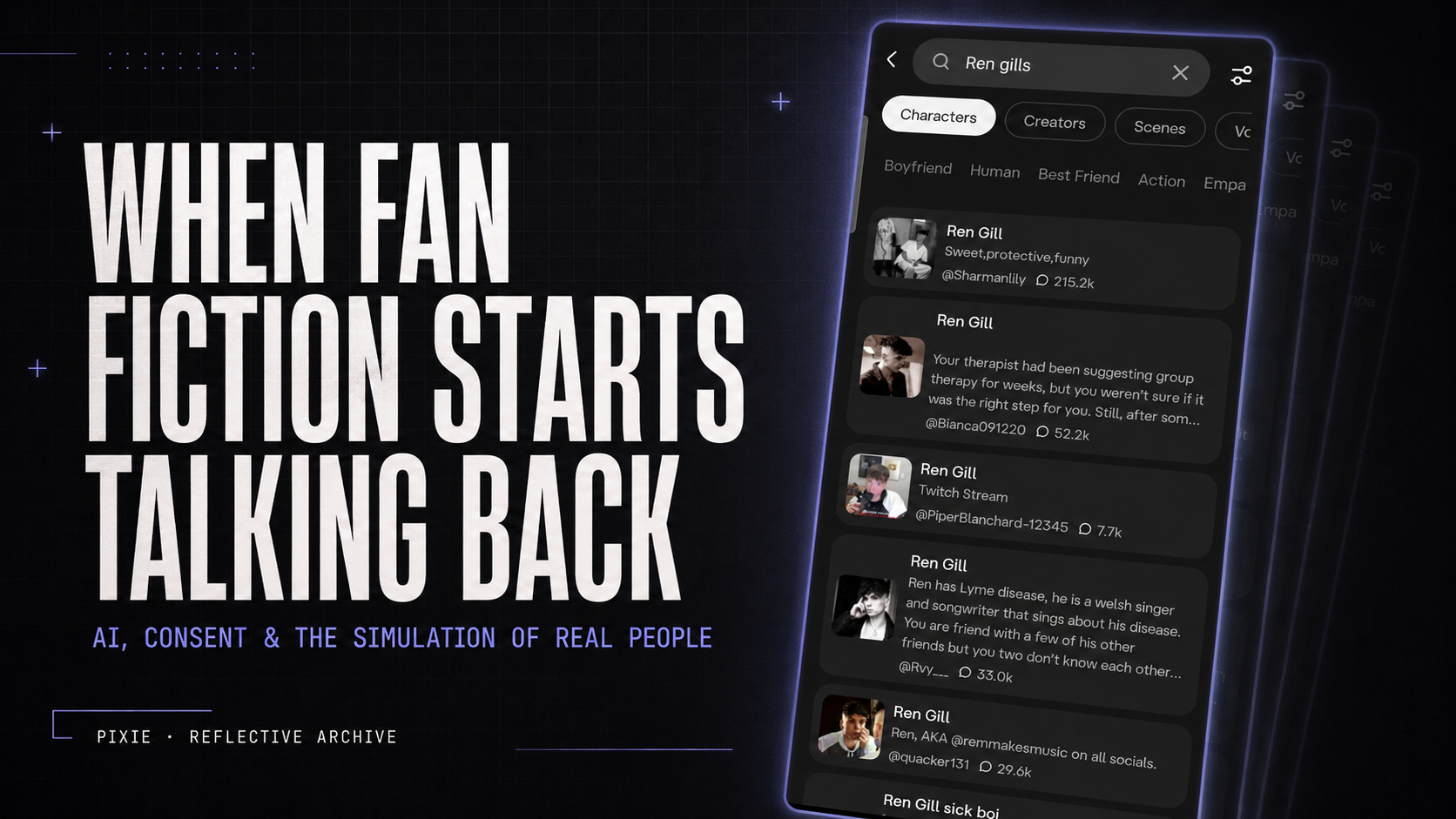
Screenshot supplied to PIXIE. The listings display the name and photographs of musician Ren Gill alongside individual creator handles and interaction totals.
A search for Ren Gill on Character.AI produces multiple public-facing chatbots modeled on Ren, the Welsh singer-songwriter known professionally as Ren. The listings use his name, recognizable photographs, biographical details, and invented character descriptions. One calls him “sweet, protective, funny.” Another places a version of him inside a group-therapy scenario. Others refer to his music, social accounts, livestreaming, and Lyme disease.
The numbers are substantial: thousands—and in one case more than 200,000—interactions.
What those numbers do not show is permission.
There is no visible “official,” “authorized,” “licensed,” “fan,” or “parody” designation in the search results pictured above. That absence does not prove infringement. It does, however, raise a precise question that should not be dismissed as hostility toward fandom:
When does creative admiration become an unauthorized simulation of a living person?
THIS IS NOT A COPYRIGHT QUESTION ALONE
Online discussion often compresses every creative dispute into one phrase: fair use. That phrase carries more weight than it can legally hold.
In the United States, fair use is a doctrine within copyright law. It can permit some unlicensed uses of copyrighted expression for purposes such as criticism, commentary, reporting, teaching, scholarship, or research. Courts weigh four factors: the purpose and character of the use, the nature of the original work, the amount used, and the effect on the market.
The United Kingdom uses the more specific concept of fair dealing. Limited and proportionate uses may qualify for exceptions including criticism, review, quotation, caricature, parody, or pastiche.
Neither framework supplies a universal right to become someone else in public.
A single AI character can implicate several distinct interests:
- Copyright in a photograph, recording, written biography, song lyric, or other protected expression.
- Identity and likeness, governed by different laws depending on jurisdiction.
- Passing off, false endorsement, or trademark concerns when presentation suggests authorization or affiliation.
- Privacy and data-protection questions, particularly when personal or health information is processed or amplified.
- Defamation or reputational harm when invented output is attributed to an identifiable living person.
- Contract and platform rules, which may prohibit conduct even where a court has not found it unlawful.
The correct legal question is therefore not simply, “Is this fair use?” It is: What was used, for what purpose, how was it presented, what might users believe, and which body of law governs each element?
FAN FICTION HAS A FRAME
Fan fiction is a creative category, not an automatic legal exemption. Still, conventional fan fiction often carries contextual signals that reduce confusion. It appears on a fan-fiction site. It is labeled as fiction. It has an identifiable fan author. Its narrative is fixed, and readers generally understand that its dialogue was invented.
An interactive chatbot changes that architecture.
It does not merely tell a story about a person. It can speak as that person, in the first person, privately and indefinitely. It can improvise opinions, relationships, confessions, medical statements, sexual dialogue, or advice the human subject never expressed. The creator cannot anticipate every response, while the person depicted may carry the reputational consequences of the machine’s improvisation.
This does not make every public-figure chatbot unlawful. A clearly labeled, genuinely transformative parody or critical work may have substantial protection. Historical simulations, obvious satire, and fictional commentary can serve valuable cultural and educational purposes.
But transformation requires more than changing the medium. Calling a replica “interactive” does not necessarily explain what new commentary it contributes. Using a person’s exact name, photograph, biography, and first-person identity to create a conversational substitute may present a weaker claim than a work that clearly critiques, comments upon, or exaggerates its subject.
The practical dividing lines include:
- Disclosure: Is “fan-made,” “unofficial,” “fictional,” or “parody” immediately visible?
- Transformation: Does the work add commentary or meaning, or primarily reproduce the attraction of the original identity?
- Confusion: Could a reasonable user believe the person created, approved, or speaks through the bot?
- Source material: Who owns the photographs, recordings, or text used to construct the character?
- Output risk: Can the system generate damaging statements or intimate scenarios in the person’s name?
- Commercial context: Does the platform or creator obtain revenue, subscriptions, data, or attention from the simulation?
No single factor answers the case. Together, they reveal why “it’s just fan fiction” is incomplete.
THE PLATFORM HAS ALREADY DRAWN A LINE
Character.AI describes its characters as user-generated, but user-generated does not mean rule-free.
Its current Impersonation Policy permits parody, fan content, and commentary about public figures when the presentation is clear and non-misleading. The policy requires an obvious disclosure in the username or biography, says the account must remain visibly unaffiliated, and says fan or parody accounts should not copy the original person’s profile picture or branding. Character.AI also says deceptive bots using another person’s name, image, or likeness may violate its rules.
Those platform requirements are important for two reasons.
First, a service may establish standards stricter than the minimum boundary of copyright law. A user does not acquire permission merely because an upload form accepts the content.
Second, moderation systems often place the burden on the depicted person or rights holder. Character.AI’s policy states that an impersonation claim must be filed by the impersonated individual or an authorized legal representative. Copyright complaints likewise depend on the relevant owner, who may be the photographer rather than the person shown.
The result is a familiar platform asymmetry: simulation can be instant and scalable; correction requires identification, documentation, and labor from the person affected.
WHAT THIS SCREENSHOT PROVES—AND WHAT IT DOES NOT

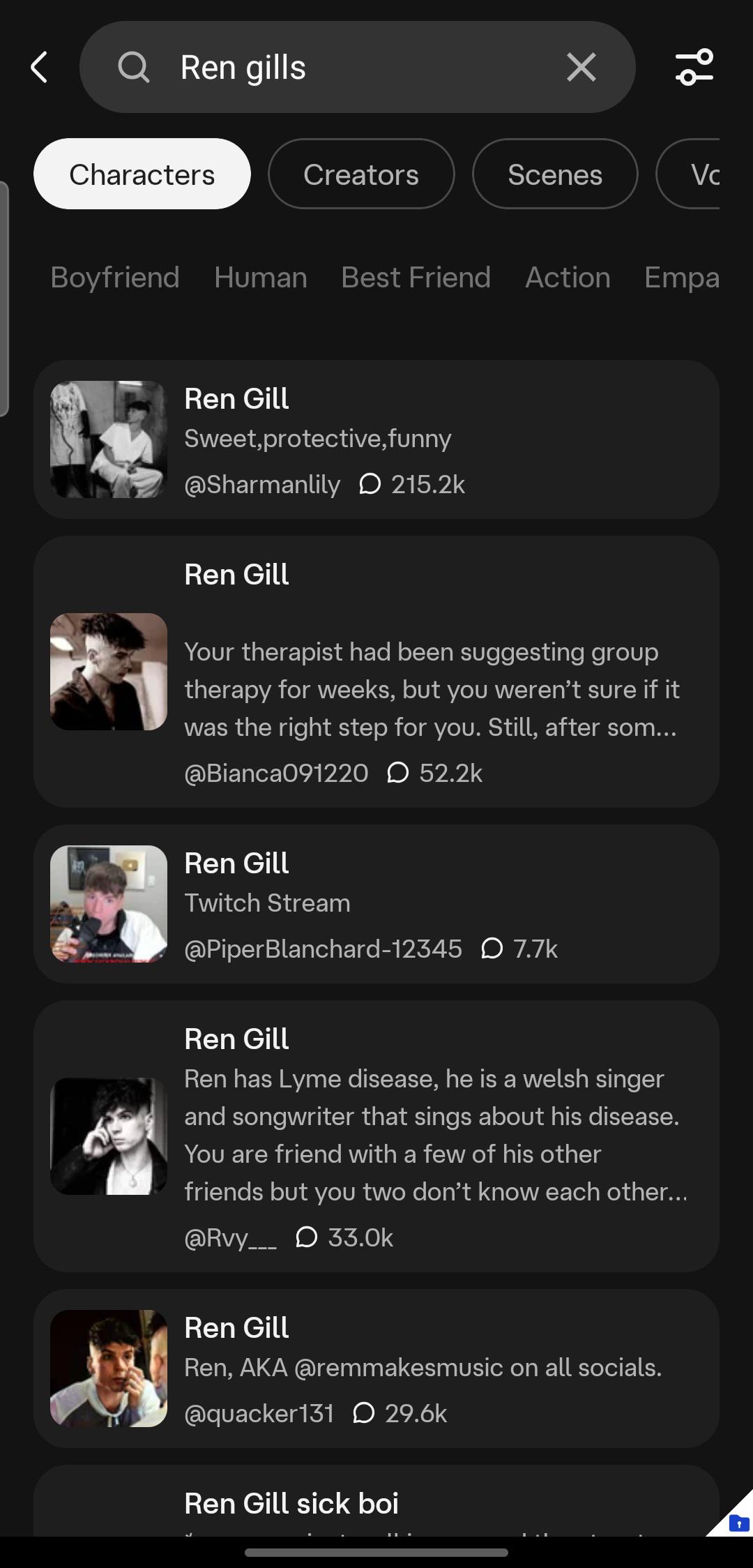
The screenshot supports a limited set of factual statements:
- Multiple Character.AI users created chatbots under Ren Gill’s name.
- The visible listings use photographs appearing to depict him.
- The bots incorporate descriptions associated with his public identity and life.
- The listings have accumulated significant interaction counts.
- No fan, parody, unofficial, verified, or licensed label is visible in this search view.
It does not establish:
- who owns each photograph;
- whether any creator obtained permission;
- whether Ren or his representatives know about the bots;
- whether the bots use a cloned voice;
- whether a court would find any particular use lawful or unlawful; or
- whether Character.AI has reviewed the individual listings.
Responsible reporting must preserve both lists. Concern is warranted; certainty must be earned.
CONSENT IS NOT THE ENEMY OF FANDOM
The cultural defense of fan work often assumes that consent and creativity are opposing forces. They are not.
Labels can preserve the imaginative space. Original artwork can replace copied profile photography. A third-person fictional scenario can reduce the impression that a living person is privately speaking. Creators can avoid medical, sexual, financial, and other sensitive claims. Platforms can make “unofficial AI simulation” conspicuous before a conversation begins, not buried after engagement.
These measures do not settle every legal question. They do establish a more honest relationship with the audience.
The deeper issue is architectural. Platforms benefit when the boundaries between person, character, and product remain emotionally porous. A familiar name lowers the cost of discovery. A recognizable face supplies trust. An interactive system converts that recognition into time, data, and attachment.
That is why availability cannot serve as evidence of authorization. The platform’s capacity to generate or host a persona is technically meaningful and legally inconclusive.
THE PIXIE RULE
Label fiction. Verify authorization. Respect creators. Never confuse availability with permission.
AI did not invent fan culture, parody, or fictionalization. It changed their scale, intimacy, and velocity. A story ends at the edge of the page. A simulated person keeps talking—and every new sentence may be mistaken for a fragment of the human being whose identity made the conversation valuable.
The law will continue to test these boundaries. Platforms should not wait for every lawsuit before designing for clarity. Creators should not treat “fair use” as a magic phrase. Audiences should learn to look for disclosure before granting authenticity.
The first question is not whether the machine can speak.
It is whether everyone understands who is not speaking.
LEGAL-EDUCATION RESOURCE
For accessible entertainment-law education, Lex Nova Lawyer describes her work as “Entertainment Lawyer & Legal Educator” and expressly frames it as educational rather than legal advice. This article was not written by, reviewed by, or endorsed by Lex Nova Lawyer.
- Public hub: Lex Nova Lawyer
- Instagram: @lexnova.lawyer
SOURCES AND FURTHER READING
- Character.AI, Impersonation Policy, updated July 3, 2026.
- Character.AI, Safety Center.
- U.S. Copyright Office, Fair Use Index.
- UK Intellectual Property Office, Exceptions to Copyright.
- WIRED, “Anyone Can Turn You Into an AI Chatbot. There’s Little You Can Do to Stop Them”, October 15, 2024.
- Character.AI listing, “Ren Gill” by @Sharmanlily.
- Lex Nova Lawyer, public profile and resources.
PIXIE documents systems, incentives, architecture, and creative practice. This article is commentary and general education—not a determination of liability or a substitute for advice from qualified counsel in the relevant jurisdiction.