The Crown Was Never the Point

Can work born from pain become an ecosystem for joy?
In March, I asked whether Ren Gill could win an EGOT in a single year.
It was a deliberately impossible question. Emmy. Grammy. Oscar. Tony. Four institutions, four industries, four different clocks. The answer was never likely to be yes. But impossibility has a way of revealing architecture. Ask what would have to exist for one independent artist to cross music, television, film, and theatre without being absorbed by the machinery that controls those fields, and the trophy case disappears. What remains is the system.
The award is the shiny object. The infrastructure is the truth.
Ren’s work makes that truth unusually visible because the independence is not simply a marketing category. It is legible in the work itself: the long-form compositions that ignore radio length, the theatrical videos that refuse to reduce themselves to promotion, the direct relationship with listeners, and the insistence that lived experience can remain complicated after it becomes public. The work does not feel independent because nobody helped make it. It feels independent because the center of gravity remains with the artist.
That distinction matters.
Independence is not isolation. It is not doing every job until the body collapses. It is not refusing money, scale, collaborators, institutions, or recognition. Independence is the ability to enter those relationships without surrendering the reason the work exists.
That is where the real conflict begins.

The wound and the product
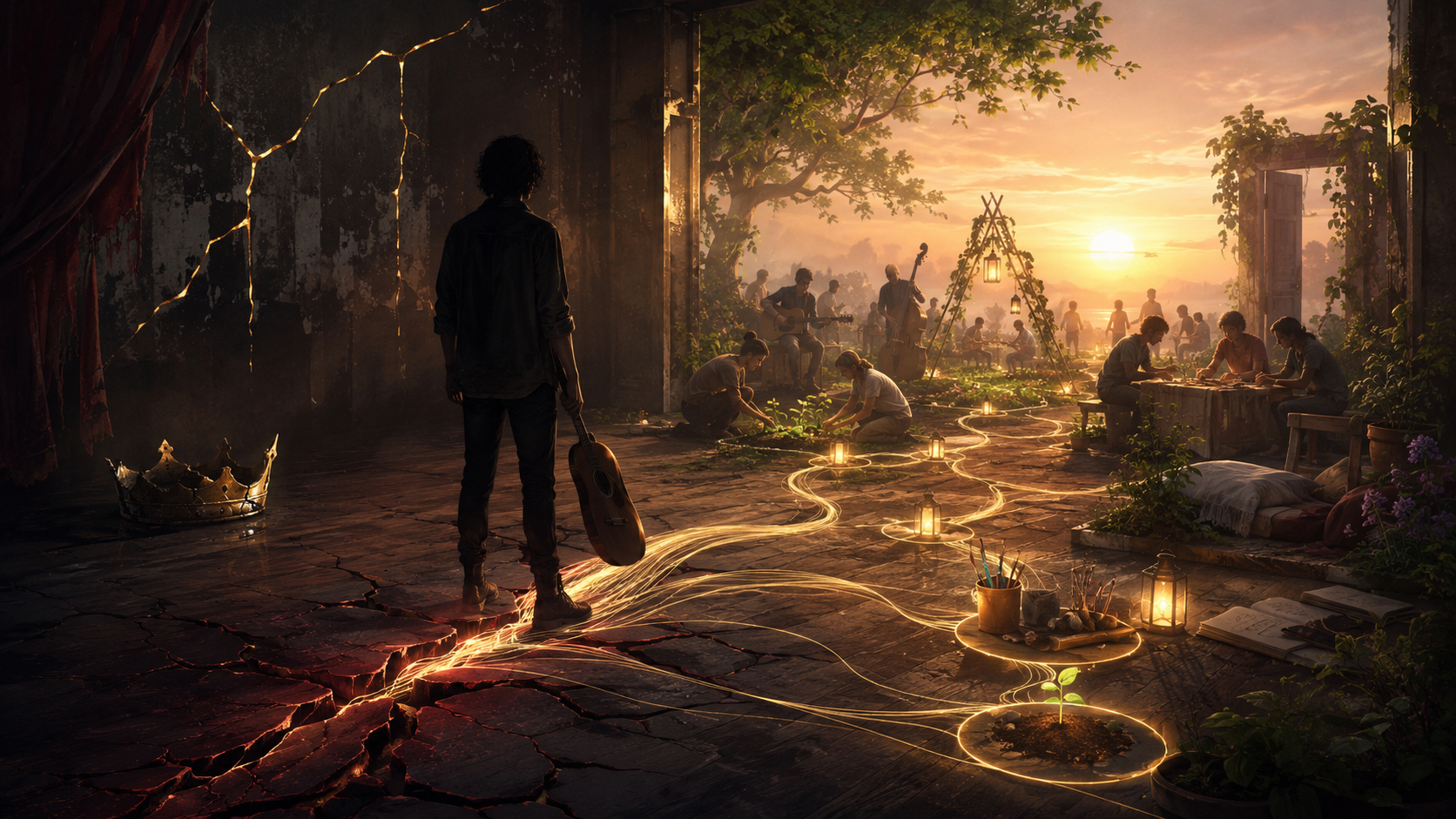
Pain can produce art. That does not make pain a production resource.
There is a dangerous economic loop available to any artist whose audience first recognizes them through suffering. The wound generates the work. The work generates attention. Attention generates revenue. Revenue creates pressure—quietly or explicitly—to return to the wound, explain it again, perform it again, package it again, and remain recognizable as the person who suffers beautifully.
The audience may not intend this. The artist may not consciously choose it. The platform does not need to understand it at all. Recommendation systems only learn that rupture retains attention.
Soon the creator faces an impossible bargain: heal and risk becoming commercially illegible, or remain inside the identity that made survival economically possible.
This is the hidden problem behind “monetizing pain.” The problem is not that money touches the work. Artists need food, treatment, rest, equipment, collaborators, and time. Refusing to pay an artist does not purify the art; it merely transfers value to whoever owns the distribution system. The problem begins when the economic structure rewards the continued availability of the injury more reliably than it rewards recovery.
The question is therefore not: Should art born from pain be sold?
The question is: What must be sold so the artist is no longer required to keep selling the wound?
Resistance after the breakthrough
Steven Pressfield’s The War of Art gives a useful name to the force that appears between a creator and the work: Resistance. It is often understood as procrastination, fear, distraction, or self-sabotage—the thing that prevents the artist from beginning.
But Resistance changes costume after success.
Before recognition, it says: Who do you think you are to make this?
After recognition, it says: Who will you be if you stop making the thing they rewarded?
For the independent artist, professionalism cannot mean endless availability. “Turning pro” must mean building conditions in which the work can continue without consuming the person who makes it. The professional shows up, yes—but the professional also builds a door, sets hours, hires help, keeps records, protects ownership, and refuses contracts that convert temporary exhaustion into permanent extraction.
The base issue is not a lack of discipline. It is that individual discipline is being asked to compensate for missing infrastructure.
No amount of willpower can simultaneously compose the music, direct the film, manage the rights, ship the merchandise, negotiate the license, moderate the community, document consent, plan the tour, protect the archive, and preserve a medically fragile body. When the system celebrates independence while leaving the independent creator to carry all of that alone, independence becomes another word for unprotected labour.
That is the trap.

What the EGOT question actually revealed
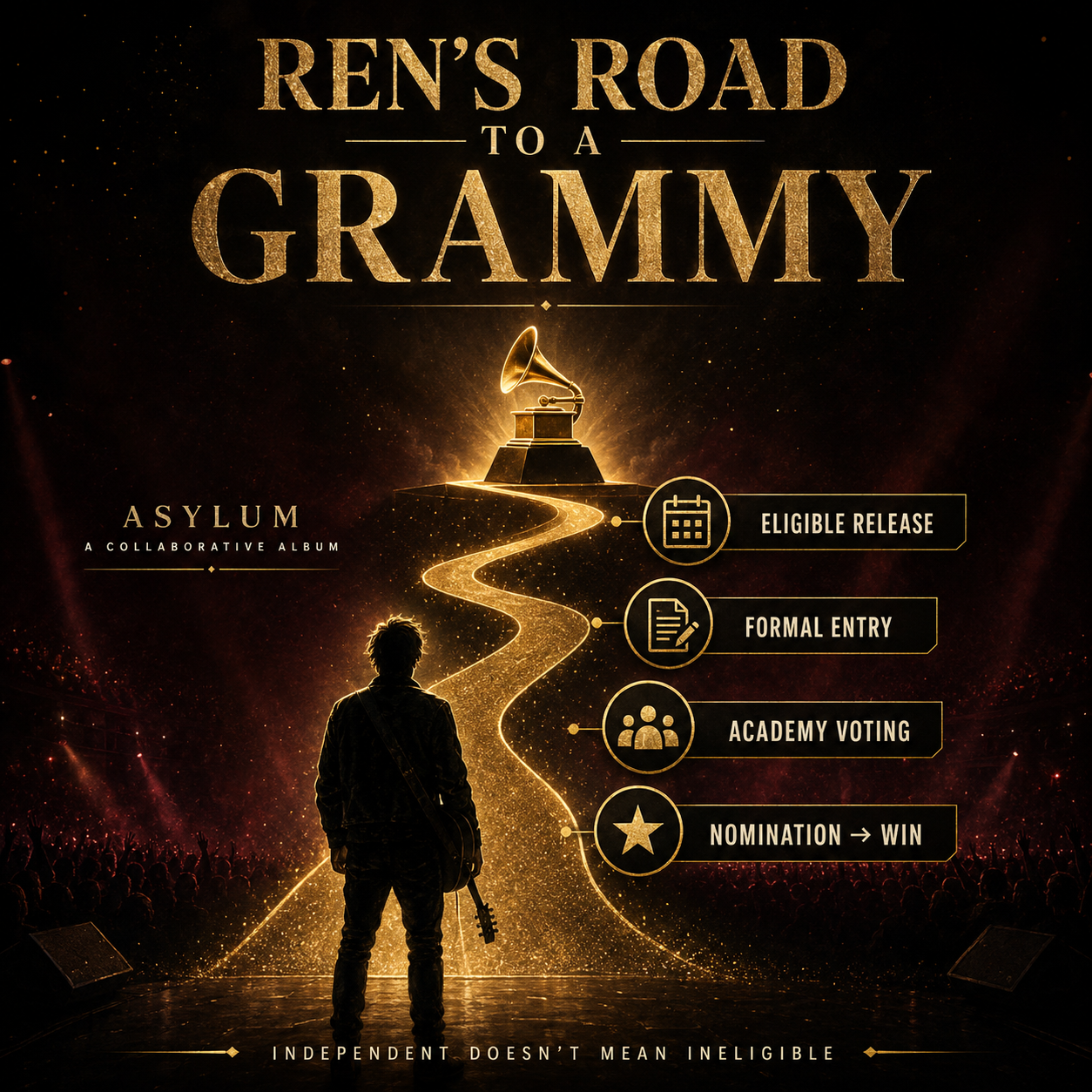
An EGOT is usually framed as proof that one person conquered four media. Seen through the independent lens, it asks something more interesting: can one body of work travel across four forms while the originating artist retains agency?
A song can become a film. A film can become a television special. A narrative cycle can become theatre. A live work can become an album. None of those transitions inherently require the artist to surrender ownership or meaning. They do, however, require an ecosystem capable of carrying the work farther than one person can.
The independent nature of the work reveals itself at each transfer point:
- Who owns the master when the song becomes a soundtrack?
- Who controls the edit when the story becomes a documentary?
- Who can alter the characters when the work reaches a stage?
- Who is credited when collaborators expand the world?
- Who receives revenue when the audience creates new value around it?
- Who can say no when a licensed use violates the work’s purpose?
- What happens when the artist needs to stop?
Awards cannot answer those questions. Contracts can answer some of them. Governance must answer the rest.
The crown was never the point. The ability to cross the kingdom without being annexed was.
An ecosystem that resolves rather than exploits the conflict
The solution is not a single platform or benevolent patron. It is a layered structure designed around one principle:
The pain may be the source material, but it cannot remain the fuel.
1. Separate the archive from the emergency
The work should be licensed as completed cultural material, not treated as an open demand for renewed disclosure. Songs, films, essays, performances, and documented conversations can continue producing value without requiring the artist to repeatedly reenact the conditions that created them.
An archive can be alive without keeping its creator in crisis.
2. Let ownership finance recovery
Masters, publishing rights, visual assets, performance recordings, and adaptation rights are not trophies. They are long-term support systems. Retaining them allows earlier work to finance later freedom—including the freedom to make joyful work that audiences did not originally request.
Revenue should purchase time, care, experimentation, and rest. That is what turns ownership into healing infrastructure.
3. Build a consent-based adaptation layer
Film, television, theatre, games, education, and community projects should not require a total sale of the world. Rights can be licensed by medium, territory, duration, and purpose. Permission for a song does not automatically grant permission for a likeness. Permission for a character does not grant permission for an artificial voice. Permission today does not need to become ownership forever.
The artist needs a rights envelope around every asset: who made it, who owns it, how it may be used, how revenue is shared, whether AI training is permitted, and how consent can expire or be withdrawn.
4. Pay the circle before the platform
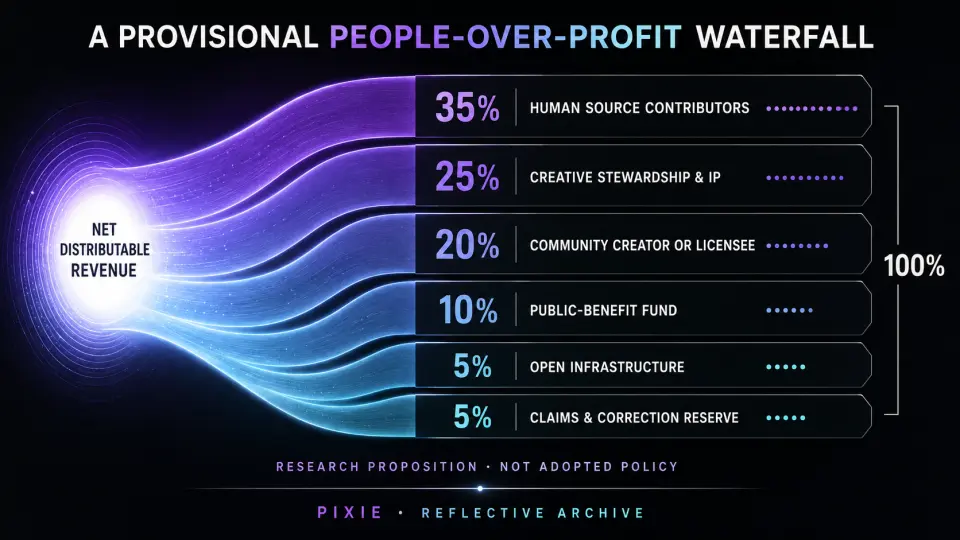
Independent does not mean singular. Musicians, filmmakers, dancers, technicians, designers, administrators, access workers, and community stewards make scale possible. The ecosystem should disclose how revenue moves and compensate human contributors before rewarding the infrastructure that hosts them.
The platform should be a service with a capped cost—not a silent co-owner of everybody’s future.
5. Create a health-and-continuity reserve
If the work emerges partly from chronic illness, sustainability cannot be modeled on a healthy body with infinite capacity. A fixed share of revenue should fund treatment, cancellations, recovery periods, access needs, and continuity pay for collaborators when the artist cannot work.
This is not charity. It is honest production accounting.
6. Give the community ways to contribute that are not consumption
A healthy audience should be able to do more than stream the most painful song again. It can fund new work, support public-interest initiatives, annotate an archive, host careful discussion, purchase ethical editions, contribute skills, attend joyful events, and help preserve the independence that made the relationship possible.
Fandom becomes ecosystem when affection acquires responsibilities.
7. Measure release, not only reach
Streams, sales, chart positions, press, and awards measure circulation. They do not measure whether the work has reduced isolation, changed clinical conversations, helped someone ask for care, financed another artist, or allowed its creator to live more freely.
The ecosystem needs different indicators: creator health, collaborator retention, rights preserved, disputes repaired, community benefit funded, new forms attempted, and days in which nobody had to perform pain for the machine.
Can pain become joy?
Not automatically. Pain is not made good because it produced something beautiful. Suffering does not become morally necessary because strangers found meaning in its expression. We should resist every mythology that makes the artist’s injury sound like a fair price for the audience’s transformation.
But pain can be metabolized.
It can become recognition: someone else has lived here too.
Recognition can become relationship: we do not have to survive here alone.
Relationship can become infrastructure: we can build conditions that do not reproduce what harmed us.
And infrastructure can make room for joy—not as denial, branding, or the compulsory happy ending, but as recovered possibility.
Joy might sound like a song that owes the wound no explanation. It might look like an artist resting while the archive continues to support the people who made it. It might be a stage production that pays every contributor and returns control at the end of its license. It might be an audience delighted, rather than disappointed, when the creator changes.
The work born from pain does not betray its origin by becoming joyful. It completes a movement the extractive system cannot imagine: the wound becomes art, the art becomes relationship, the relationship becomes structure, and the structure makes the wound less necessary.
That is a crown worth building—not one placed on a single head, but an ecosystem sturdy enough that nobody has to bleed forever to keep it shining.
Context and further reading
- Happy Birthday Mr Gill — the original EGOT question.
- The Trap for Ren — independence, scale, ownership, and operational exhaustion.
- Licensing as Organizational Infrastructure — a people-over-profit framework for consent, attribution, compensation, and reuse.
- Steven Pressfield: Who owns—and how are artists paid for—art?
- Steven Pressfield, The War of Art — particularly the concepts of Resistance and professional practice.
This essay interprets publicly available work and does not speak for Ren Gill or his collaborators.