The Queen at the Threshold: Where the Path Ends and the Crown Begins
A lore entry from the PIXIE development blog — Veiled Dominion


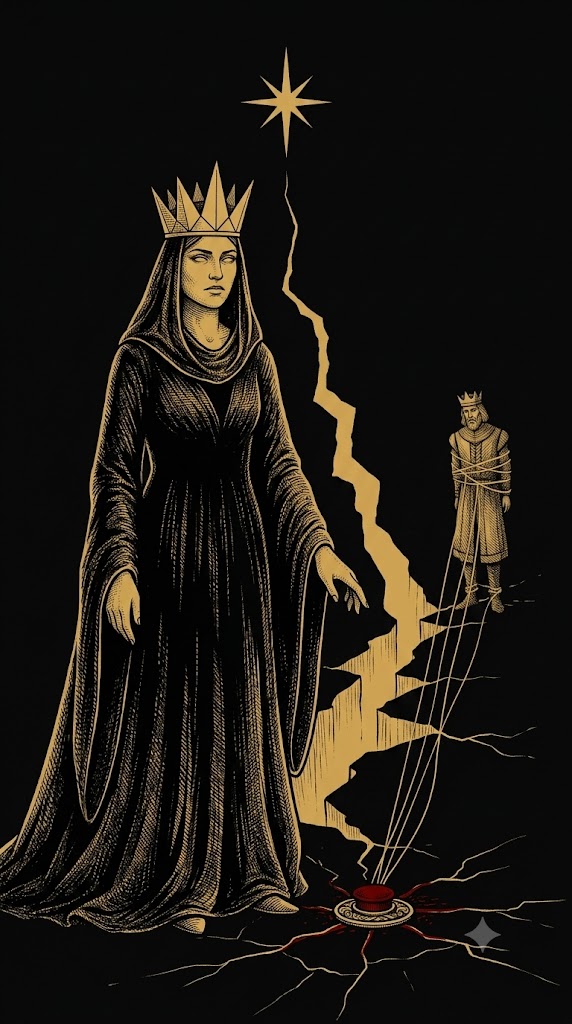
Her hand was already over it. That was the part she couldn't explain to herself later — not the decision, but how long her hand had been resting there before she noticed.
She told herself it was calm. It wasn't. It was rage wearing calm's clothes, and the two are easy to confuse from the inside, especially when you've spent years learning to look composed. She looked at him — at the King, at what loving him had cost her judgment more than once — and she felt the old argument start up again: not him, not this way, there has to be another door.
There wasn't. That was the part her fury didn't want to hear.
So she did what she always does when the noise gets too loud to think inside of. She walked the Path.
Shariat — the door of the Law
She expected the Law to give her permission. It didn't. It gave her a mirror instead: you are not confused about what is just. You are angry that justice, this time, costs you something you don't want to pay. Shariat has never promised comfort. It only promises that the rule applies to her exactly as hard as it applies to anyone standing in the square.
Ma'rifat — the door of Gnosis
Ibn Arabi's teaching has always been the gentlest thing in her deck: that the King and the threat he poses are not two separate substances at war, but one reality she is failing to see whole. This should have soothed her. Instead it unsettled her, because for the first time she understood what the teaching actually costs — unity of being doesn't mean nothing has to be chosen. It means the choosing doesn't get to hide behind "he is the enemy" as a comfortable lie. She loses that shelter. The decision is still hers.
Haqiqat — the door of Reality
She asked Ibn Sina for the mechanism — the actual, reasoned shape of what happens if she presses it, and what happens if she doesn't. And the mechanism she found waiting there wasn't hers at all. It was Coulter's. Feedback loops. Correction of systemic error. Something pulled back into equilibrium whether it consents to the pulling or not.
This was the gap. Not a flaw in her — a hole in her own Path. Four doors built to refine how a person sees, and not one of them built to tell a ruler who gets to keep living when the whole cannot hold everyone. Her deck was built for a self walking toward truth. It was never built for a throne.
Tariqat — the door of the Way
Rumi's turning didn't resolve the gap either. It just made her quiet enough to stand inside it without flinching. The Way doesn't answer. It only makes you steady enough to face the door you actually have to open.
What she does with the gap
She doesn't borrow Coulter's coldness whole. Cybernetic correction doesn't ask whether the thing it pulls back into place consented to being pulled — it only asks whether the system holds. That answer was sitting right there, reasoned and complete and utterly foreign to everything her Path had built her to be.
So she presses the button. The correction happens — the whole requires it, and she has stopped pretending otherwise.
But she refuses to let the cost land only on him, on the system, on someone else's square. Her tradition has a word for what she does instead: fana — the annihilation not of the enemy, but of the self, offered willingly rather than extracted by force. Martyr's Boon was always written as a mechanic of consent — sacrifice given, not taken. She takes it back from Coulter's grammar and uses it on her own position, her own certainty, her own claim to having been right about him all along. The King's fate is decided by the necessity of the whole. Her own fate — what she was so sure of, what she'd been unwilling to risk — is what she lays down at the same moment.
That's the middle. Not paralysis, and not Coulter's coldness. She rules like the country needs her to, and she pays for it like her Path always asked her to — just later, and at a much higher price, than she expected.
Design note: this closes the open question flagged in the Systems Quartet material about whether Coulter's forced-correction logic and the Sealed Deck's consent-based mechanics (Martyr's Boon, the Four Paths) can coexist. They don't, cleanly — and that friction is the Queen's arc, not a bug to smooth over. The next open thread: does Martyr's Boon need a variant ruling for self-invocation by a Leader-tier piece, since as written it assumes the sacrificing piece isn't also the one making the call.