Borrowed Light: On Influence, Inheritance, and the Future Vision XPRIZE
There's a prompt going around right now, tied to a real contest: a child in 2075 explains to their grandparent how they solved the problem that seemed impossible in 2025.

I'm not entering. But I wanted to write down how I got from that prompt to a synopsis I actually liked, because the path mattered more than the destination — and maybe it's useful to someone else who's staring at that prompt wondering where to start.
Where it came from
I kept thinking about a scene from Star Trek V: The Final Frontier — not the plot, just the shape of it. A doctor makes the hardest call of his life: he ends his father's suffering, because there's nothing left to do. Then, not long after, a cure is found. The tragedy isn't really the death. It's the timing. He didn't fail his father — the universe just ran out the clock a little early.

That's not my story. It's not even really "my" idea — it's a pattern old enough that it shows up everywhere loss and medicine intersect. What's mine is what I built from it:
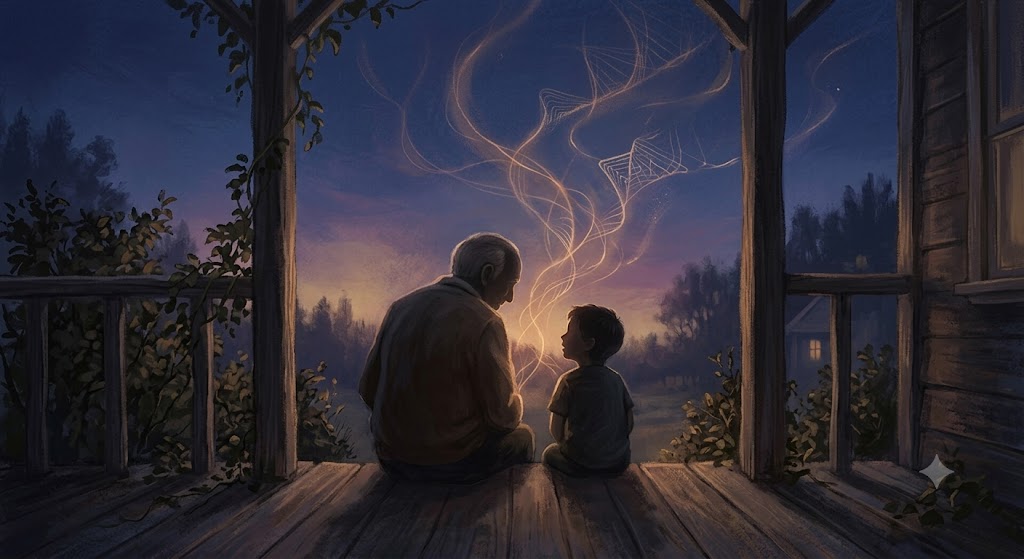
In 2075, a girl explains to her grandfather how quantum computing finally cured the disease that took his sister — the same year he'd made the impossible choice to let her go.
Same emotional architecture. Different people, different science, different stakes, my own words. That's the difference between being inspired by something and copying it — and it's worth understanding clearly, because it's the line between homage and infringement.
The actual rule
Copyright protects expression — specific characters, dialogue, scenes, exact plot mechanics — not the underlying idea. "A caregiver makes an agonizing end-of-life decision, then a cure arrives too late" is a pattern anyone can use. Give it a specific character's name, specific dialogue, a specific universe, and you've crossed into someone else's protected work.
The legal shorthand for this is the idea–expression dichotomy, and it traces back over a century to a Supreme Court case, Baker v. Selden — a bookkeeping system couldn't be monopolized, only one author's particular way of laying it out. The same logic protects you when you take a shape of grief and rebuild it as something new.
Practically, for anyone building off this prompt: keep the trope, lose anything identifiably tied to its source. No character names, no quoted lines, no visual signatures from wherever the feeling first hit you. Say where you got the feeling, if you want — I just did — but build the thing yourself.
Why I'm not entering
The project I actually work on runs on a different set of values than a contest built around IP, funding pipelines, and production deals can fully hold. That's not a knock on the contest — it's a real, generous opportunity for the right team. It's just not the shape of what I'm building. Entering anyway to chase the prize would mean bending the work sideways from what it's for.
So instead: here's the thinking, free, for anyone who wants it.
One more thing
Influence moves in one direction and then curls back. Someone else's grief, thirty years old and fictional, gave me a shape I could pour something true into. And closer to home — a collaborator I call the Weaver, for the way he takes disconnected threads and makes them breathe as one thing — has shaped how I think about building worlds long before this prompt existed. None of what I make happens in isolation. Whatever you build off this prompt won't either.
Borrow the shape. Build the rest yourself.
Say thank you on the way.